
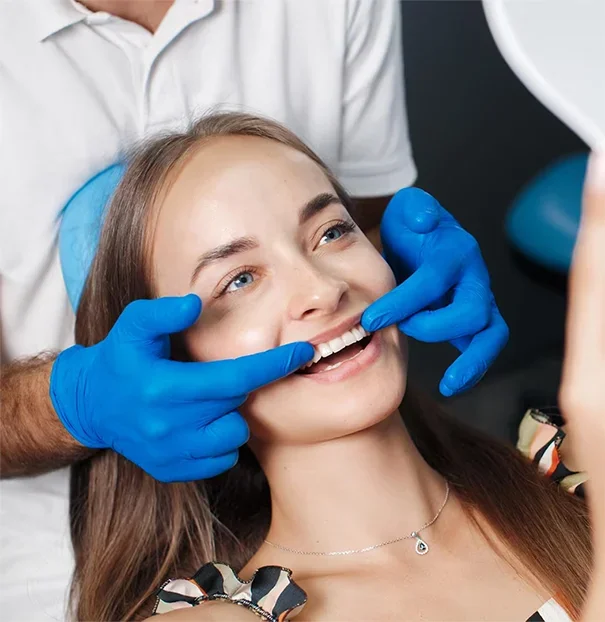
I get this question almost every week. Someone points at a chip, a gap they have hated since high school, or a tooth that looks off in photos, and asks what I would do. Usually the answer is one of two: bonding or porcelain veneers. They fix many of the same problems, but they are not the same treatment, and the differences in cost, time, and lifespan are bigger than people expect.
Key Takeaways
- Bonding is the fast, budget option. One visit, but it chips and stains sooner than porcelain.
- Veneers cost more and take a few visits. You get porcelain that resists stains and lasts.
- No universal winner. It hangs on your teeth, budget, and how permanent you want it.
Look at your smile in a photo, and you probably fixate on the same things I hear about all day. A chip. A gap. One tooth a shade darker than the rest. Rarely a health issue. It just bugs you, and that is reason enough to fix it.
For a cosmetic touch-up like this, two options come up over and over, and any decent cosmetic dentist in Houston should lay them out: dental bonding and porcelain veneers. They overlap a lot. Where they split is in speed, price, and permanence.
Which is right for you? Depends. Let me walk through each, then what usually settles it.
What Dental Bonding Actually Is
Bonding is the low-drama option, the one I reach for when someone needs a quick fix. I take a tooth-colored resin, sculpt it onto the tooth by hand, and set it with a curing light. Done, usually in one visit, often with no drilling or numbing.
That light touch is the appeal. I am barely altering your tooth so that bonding can be undone later, unlike veneers. The catch is durability. Resin is softer than porcelain, so it can chip on something hard and slowly takes on color from coffee, tea, and wine.
Bonding is a solid pick for:
- A small chip or a rough edge that catches your lip
- Closing one narrow gap
- Evening out a single tooth that reads darker
Where Porcelain Veneers Come In
Veneers are the heavier lift and the longer-lasting one. Each is a wafer-thin porcelain shell, made in a lab to sit over the front of a tooth in the shade you pick. Bonded on, they hide chips, gaps, odd shapes, and deep stains at once.
The process asks more of you. I buff away a thin layer of enamel so the veneer sits flush, and that does not grow back, so this is permanent. You wear temporaries while the lab works on them. The payoff is porcelain that resists stains and, treated right, lasts ten to fifteen years.
Veneers make more sense when:
- You want several teeth changed together
- Whitening has failed on deep, set-in stains
- You are after a bigger redesign, not a patch
Cost and How Long Each Lasts
Here is where they really diverge. Bonding is easier on the budget upfront, sometimes by a lot, which is why people say yes on the spot. Veneers cost more at the start. Before that decides it, look at the lifespan.
Bonding tends to need a touch-up or redo after several years. Veneers usually go longer. So the cheap fix can now quietly cost more over ten or twenty years, while the pricier one can be decent value if you look after it. I will not throw out a number here, since it swings with how many teeth we treat.
The quick mental math:
- Bonding: cheaper today, shorter run
- Veneers: pricier today, longer run
- Judge by cost per year, not day one
What the Appointments Look Like
The calendars look nothing alike either. Bonding is a one-shot appointment. I build up the resin, shape it, polish it, and you leave that day with the tooth fixed. An hour or so, longer for a few teeth.
Veneers stretch across two or three visits. A prep appointment, impressions to the lab, temporaries in the gap, then a trip back to bond the porcelain. Ballpark a couple of weeks, sometimes more.
Roughly, the timing looks like this:
- Bonding: one visit, you walk out fixed
- Veneers: two or three visits across a few weeks
- Veneers mean living in temporaries for a bit
Which One Fits You
When a patient is torn, I ask a few blunt questions. How much are you trying to change? How long do you want it to hold? What are you comfortable spending? And how healthy is the tooth underneath, since both need something solid to build on?
Your habits matter more than people think. Grind at night, crunch ice, live on coffee and cabernet? That pushes you toward one material over the other. My job is to weigh it all and point you to what fits, not what sounds fanciest.
Things to sit with before you decide:
- How many teeth are in play
- Whether keeping it reversible matters to you
- Today’s budget against the long-run cost
So, Bonding or Veneers?
Strip away the details, and you are trading speed for staying power. Bonding is a fast, affordable fix you can freshen up later. Veneers cost more and take more chair time, then repay you with porcelain that lasts and keeps its color. Both look natural when the work is good.The real answer lives in what a phone camera cannot catch, which is what an exam is for. The team at Le Blanc General Dentistry & Aesthetics can take a proper look, hear what you are after, and tell you straight whether bonding, veneers, or a mix makes sense. Book a bonding or veneer evaluation in Houston for a real answer.